
Recently, the astronomical community has been made aware of the discovery of several new comets, with one in particular poised to capture public attention: C/2025 A6 (Lemmon). This comet, discovered by the Mount Lemmon Survey in Arizona on 3 January 2025, is classified as non-periodic. Lemmon’s orbit brings it close to the Sun only once every 1,350 years, making this a truly rare event.
On 8 November 2025, the comet will reach its closest point to the Sun, known as perihelion, at a distance of just 0.53 astronomical units, or about 79 million kilometres. As comets approach the Sun, the increase in temperature causes their icy components to vaporise, resulting in the spectacular tails that are often visible from Earth.
I started reflecting on Lemmon’s previous visit, which occurred around the year 675 AD. The world at that time was vastly different: Europe was in the midst of the Early Middle Ages, the Byzantine Empire was flourishing under Constantine IV, and the Tang Dynasty was a centre of cultural and technological innovation in China. The Islamic Caliphate was advancing new ideas, and the Maya civilisation was constructing remarkable cities in Central America. It is intriguing to imagine that people living around 675 AD witnessed Lemmon’s passage, perhaps interpreting it as an omen or a sign from the heavens, as was common in many cultures.
The first comet recorded in the Anglo-Saxon Chronicles was in 678 AD, “HER ATEOWEDE COMETA AND SCAN III MON AS AELCE MORGEN SWlLCE SUNNE BEAM.” “In this year appeared the star called comet, in August, and shone for three months each morning like a sunbeam.”
Could this have been our comet Lemmon?
Determining whether C/2025 A6 (Lemmon) was a prominent feature in the night sky during its last visit is challenging. Comets with orbital periods over 1000 years can have extreme semimajor axes and eccentricity, and can fluctuate significantly in their orbital path. Also, the brightness of a comet depends on several factors, including its size, composition, and the amount of ice and dust it contains. Unfortunately, historical records from the 7th century are limited, so we cannot say with certainty how striking an appearance may have been. However, given its close approach to the Sun, it is plausible that Lemmon was a noticeable and memorable sight.
Whatever this comet was, it had a lasting effect on Saint Wilfrid of York, who was a powerful Northumbrian bishop in the seventh century who ruled a large number of monasteries. In the year 678, when the comet appeared, it was seen as a bad omen, and Bishop Wilfrid was driven from his bishopric after quarrelling with King Ecgfrith of Northumbria.
Happy comet hunting all
Also appears as Oct enews Chair Chat – Society for the History of Astronomy
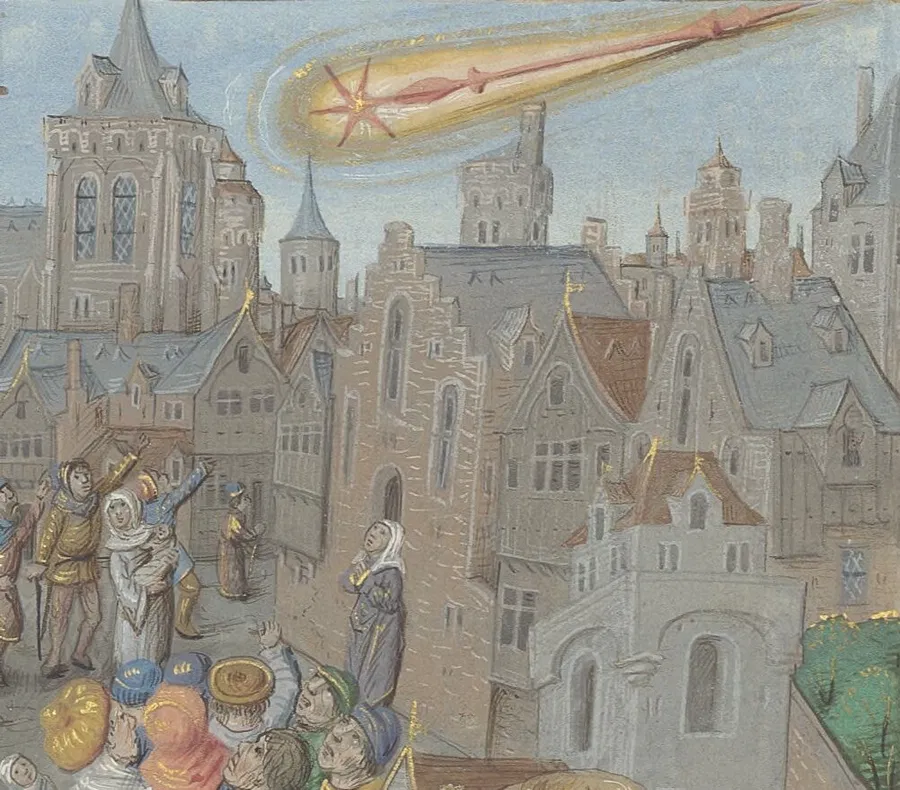
Bibliothèque de l’Arsenal, Ms-5206 réserve, fol. 152r
 Archaeoastronomy Cornwall