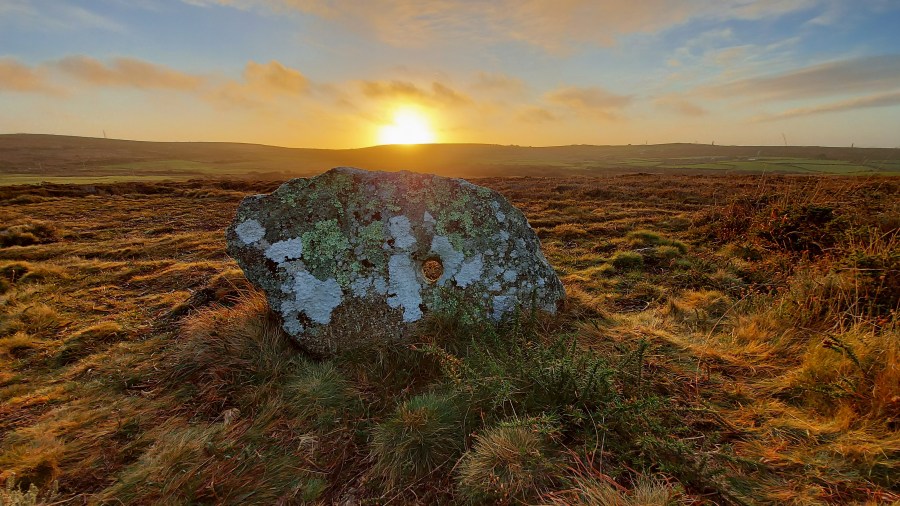
Were the holed stones a cosmological calendar?
Written after the April 2023 archaeological investigation of the stones
Adjoining the ritual landscape of Tregeseal near St Just, Cornwall lay a curious collection of stones known as the Kenidjack Holed Stones, which are named after the common land on which they are sited (Latitude 50.1360°, Longitude -5.6537°). The site consists of four large granite slabs each perforated with a circular hole currently positioned in a row with an ENE-WSW orientation of 67°, with a further fifth smaller holed stone a few meters to the NW of the main row. The stones are distinctive due to being a collective group with holes, and while there are other examples of holed stones in west Cornwall (including a number near the Merry Maidens stone circle), it is unusual to find a group of them together. It is considered that they are most likely a collected monument which relates to the local Bronze Age barrows, stone circles and other monuments within the immediate location. They were drawn in 1842 by John Buller laying prone on the floor.[1] All the stones have likely fallen and been re-erected a number of times. In 2020 one of the stones became loose and fell over, the hole in which it had sat was very shallow and although it was propped back up it needed to be reset in the ground in a more robust manner. By 2023 a second stone was also becoming loose and this led to the opportunity to examine if there was any evidence of their original positions in the ground immediately surrounding them or if these had been lost. The archaeological investigation was led by Peter Dudley of the Cornwall Archaeological Unit with support from Laura Ratcliffe-Warren and a team of volunteers from the Penwith Landscape Partnership. Historic England grant-funded the work as part of the monument management programme of conservation works.
The monument consists of the four larger stones in the row and a further outlier stone to the main row. The stones in the row have been called A-D for the purposes of this investigation (with E being the outlier). Three stones in the row are upright while the fourth lays prone and broken with only half of its hole still visible (as it was drawn in Buller’s early sketch). The smallest holed stone is an outlier to the NW of the row and has likely been moved from its original position and re-erected with a viewpoint of the outcrop of the top of Carn Kenidjack in mind. It was photographed in 2010 broken in two and has been reset in its current location.[2]

Image: Stone Row with each stone labelled from A – D
Credit: Carolyn Kennett
Stone A and Stone C were subject to the archaeological investigation conducted over two days in late April 2023. Two separate 1.6 x 1.2m trenches were opened up in the immediate area around stones A and C before both were replaced in the same position as before the conservation works. In an effort to make stone C more secure it was reset with its long edge into the ground and short square edge at the top. The chosen side being matched to Charles Henderson’s 1922 drawing of the stones.[3]
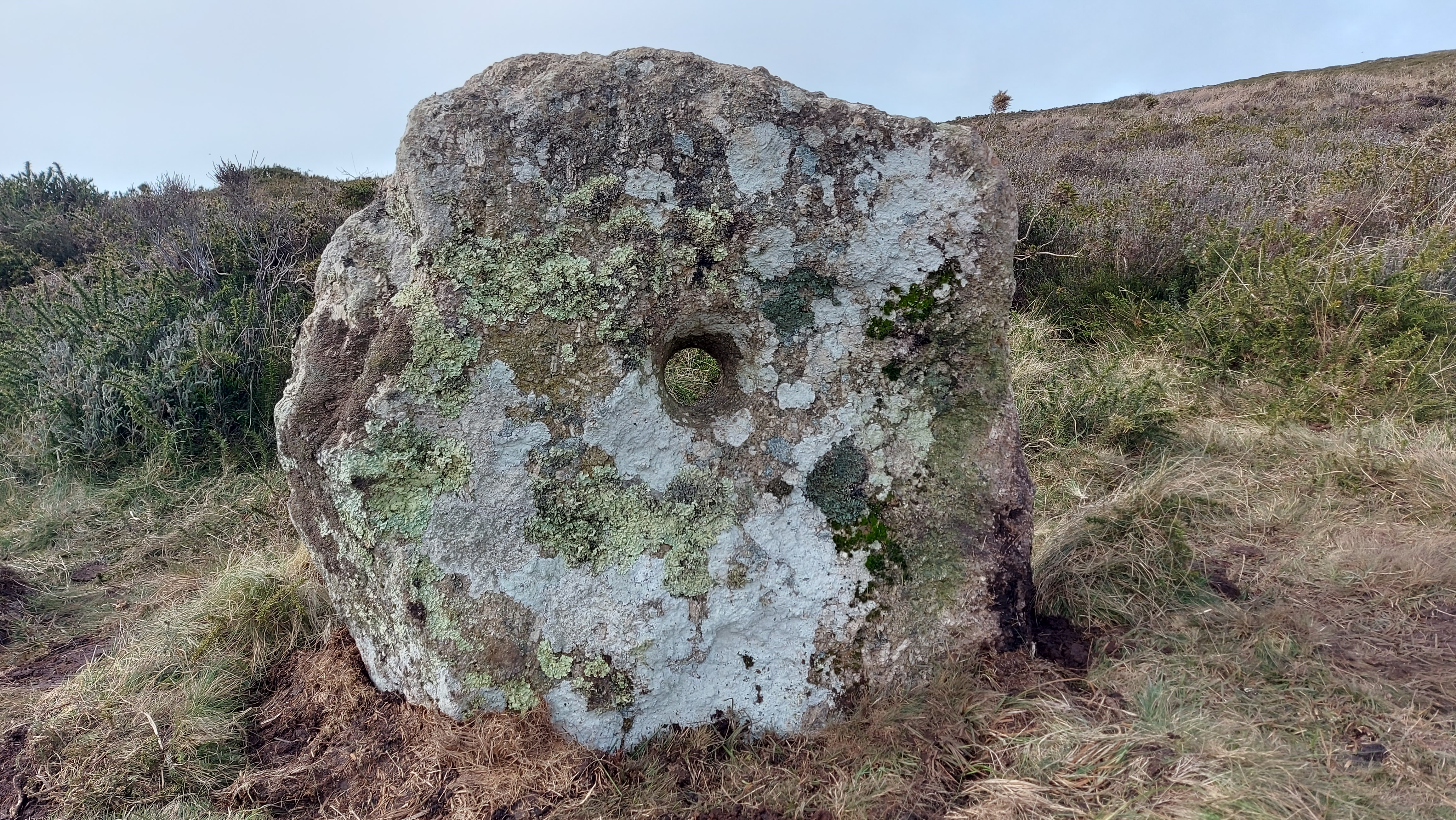
Image: Stone C following the 2023 conservation works
Credit: Carolyn Kennett
There was no evidence of any original setting or ground disturbance relating to Stone C. In Charles Henderson’s drawing, he has this stone positioned closer to Stone D and this could be the reason that no ground disturbance was found.
Beneath the location of Stone A the team uncovered the edge of a possible large pit or hollow, with a fine greasy layer at its base. From its texture, the layer was possibly organic-rich in its composition. Within this was a discarded rough flake of flint (also burnt), knapped off from the outer edge of a flint nodule. It is difficult to date the pit/hollow, especially considering the later changes to the monument. It could potentially date from the erection of the monument and perhaps indicate that there was a fire in the vicinity of the stone, however, without full excavation, a fuller understanding is difficult to establish. Care was taken not to change the orientation of the stones although Stone A was buried approximately 20cm deeper than it had previously been to ensure its long-term stability.
It was concluded that the monument had undergone disturbance in both orientation and original positioning of the stones. The earliest description of the stones has them positioned in a line and there is nothing to suggest they would have stood in any other way. The 2023 archaeological investigation found little indication of their original position. Therefore the following is a suggestion of what may have proved interesting about the holes and related skyscapes at the site during the Bronze Age, rather than a definitive conclusion about the orientation of the stones, holes and related skyscapes. This examination tentatively discusses the possible role of the holes in their relationship to the cosmos while taking into account the challenges of orientation.
Looking directly through the holes
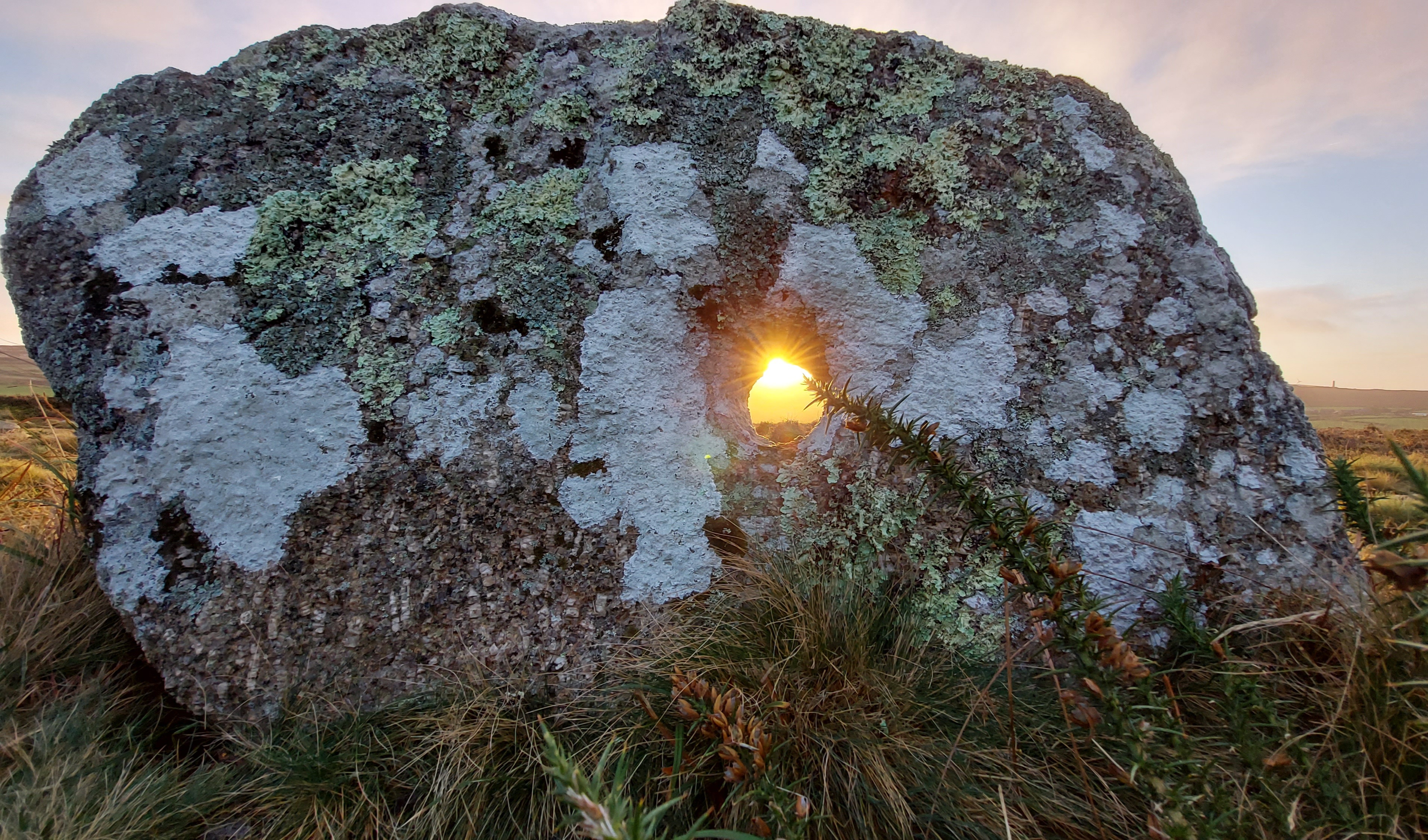
Image: Sunrise through stone D, 17th December 2021
Credit: Carolyn Kennett
The stones are located on the side of an eastern slope leading up to Carn Kenidjack and keeping this feature in sight at the monument may have been important in the choice of location of the row. Each hole is positioned low on the stone and the rise in slope makes it impossible to observe the sky when looking towards Carn Kenidjack through the holes, and you can’t see the sky in this direction. Looking through the holes in the opposite direction gives a slightly different view of the southeast horizon, as the stones are each positioned at a different angle in the row. Due to the aspect of the site and the rise in slope, it makes more sense that any observations of the sky made through the holed stones would be limited to this general direction. The current orientation gives sightlines through the holes with azimuths between 105° and 135°. This relates to rising objects of the celestial sphere and it is possible to see the sun, moon and a number of stars in this direction as they move through their celestial cycles. The stones could have been orientated to watch for seasonally important sun and moon rises or helical-rising stars maybe marking chosen calendrical events.

Image: Horizon positions which are observable through the holes (pre-archaeological investigation)
Credit: Carolyn Kennett

Image: Profile of horizon (horizon scale exaggerated x7)
Credit: Graphics by HeyWhatsThat
After the investigation, Stone D’s orientation to the furthest southeast part of the horizon remains unchanged. Stone C was orientated towards the ESE, resetting the stone hasn’t changed this orientation by much and it still faces the lower ground between the two ridges on the horizon.
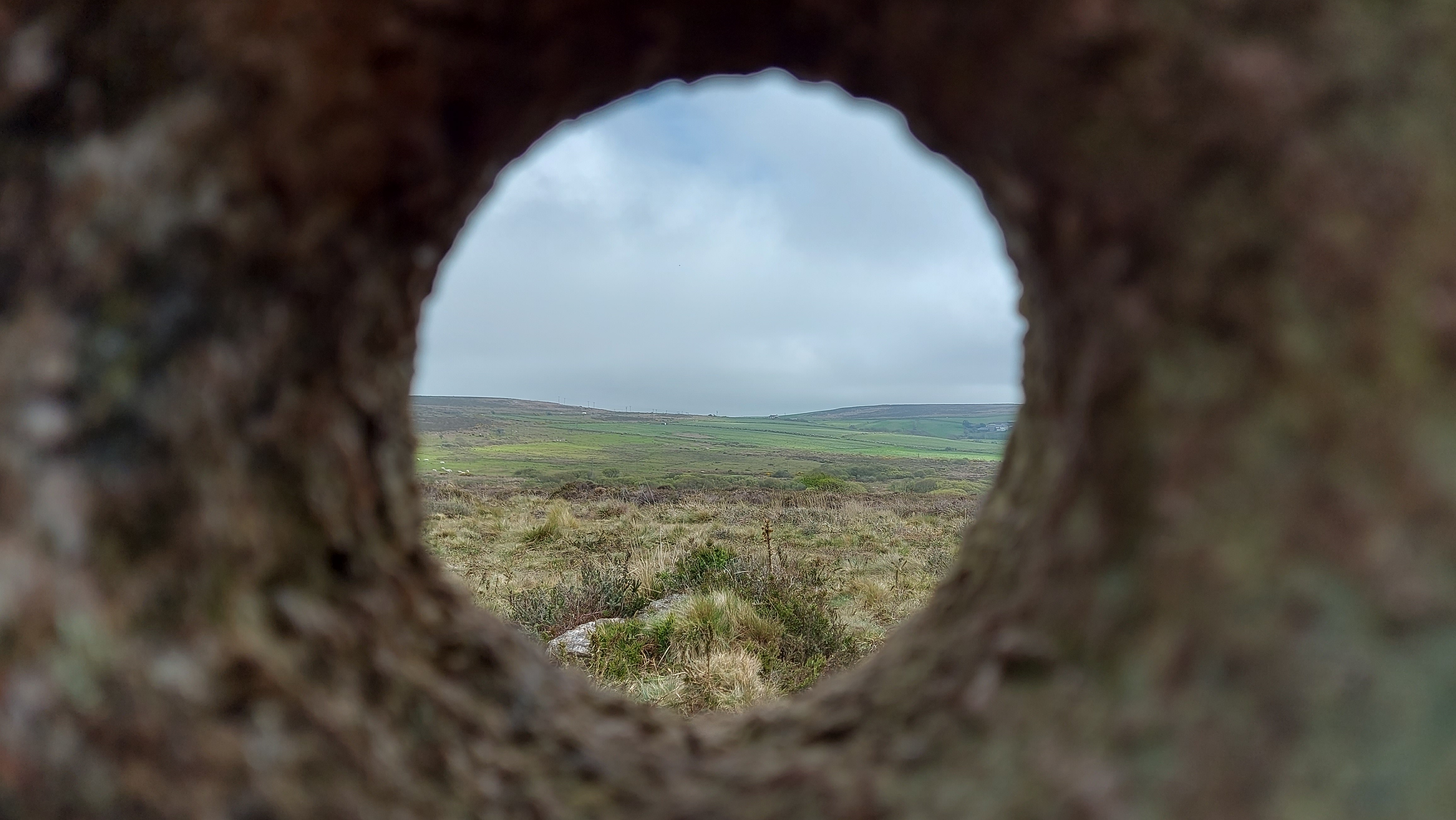
Image: Horizon view through Stone C following the 2023 conservation works
Credit: Carolyn Kennett
Stone A is orientated centrally of the three. This orientation changed little after the stone was reset and still was centred on the distant southeast ridge. When looking directly through the holes at the horizon there is a crossover with Stone C and D’s views.

Image: Horizon view through Stone A following the 2023 conservation works
Credit: Carolyn Kennett
The sun and the holes
The sun changes its rising position throughout the year, rising directly in the east at the equinox and furthest to the northeast for the summer solstice while rising at its furthest point to the southeast at the winter solstice. If the stones were orientated in the way they are today there would have been times when the sun would rise and shine directly through the holes. Could the holes be used to observe the rising sun through them?

Image: Sunrise through stone A, 1st December 2019
Credit: Carolyn Kennett
The location of the holes low to the ground gives an uncomfortable observing position and looking directly at a rising sun is fraught with danger as the sun can cause serious damage to the eyes. There is an alternative way in which the sun, hole and stone could work in unity. Instead of looking directly through the hole, an observer waits until after the immediate sunrise for a shadow to form behind the stone. The shadow only takes minutes to form after sunrise and if the stone is orientated to a corresponding part of the horizon where the sun rises a beam of light shines through the hole onto the ground.
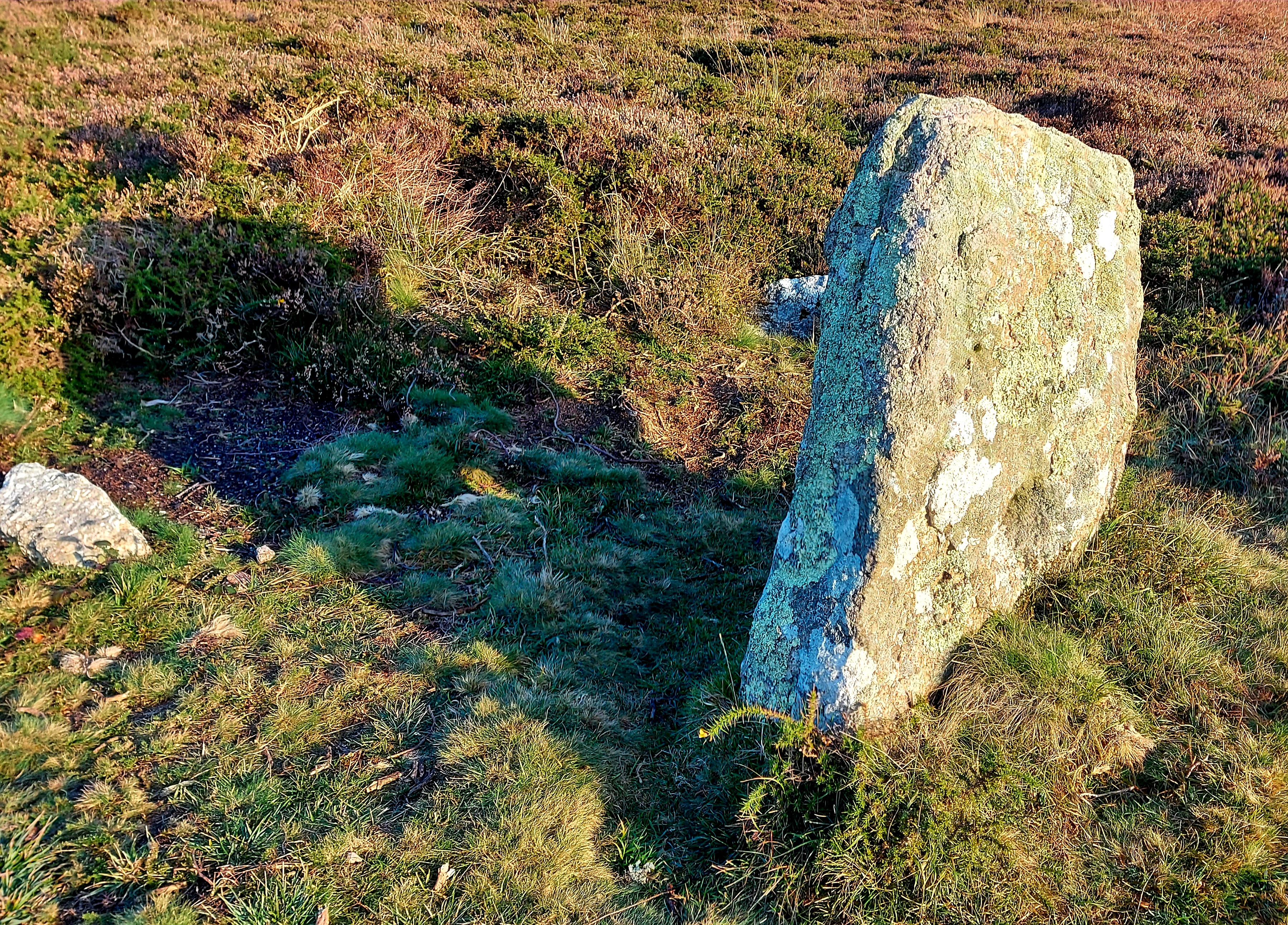
Image: Sunrise through stone A, 6th December 2020
Credit: Carolyn Kennett
The rising sun will form a circular sun beam onto the stone’s shadow. The connectivity between the sun, stone and shadow may have been of interest to the people who created the holes in the stones. As a phenomenological effect, it could have been perceived as a mastering of the sun itself (a possible deity) by casting it down, bringing it to earth while shrinking it and harnessing its power and warmth at ground level. I can speak from experience when I say that the concentration of sunlight shining through the hole is a great way to warm your hands on a cold morning! Alternatively, It could have been seen as a demonstration of light overcoming darkness, with the sunbeam forming centrally in the dark shadow behind the stone.

Image: Sunbeam shining through the hole captured onto a piece of card
Credit: Carolyn Kennett
The sunbeam is an ephemeral, time-sensitive feature. It would only be visible within the shadow for a number of consecutive days, for a few minutes at a time. All the holes are of similar diameter and in theory this would allow the holed stones to be used as a rough calendrical device from the number of days the sun would shine through the hole. If the holed stones were standing similarly to their current positions then each hole aligns with a different set of sunrises which partly overlaps because of the view of the horizon through the holes.
The angular diameter of the sun, corresponding hole and distance to the eastern horizon means that the sun would shine directly through the holes for approximately 20 consecutive days (there is some discrepancy in this as the daily displacement of the sun is not uniform during the solar year). In their current positions Stone C correlates to the sun rising from early November to late November, stone A corresponds to dates from late November to mid-December and Stone D relates from early to late December including the rising sun at the winter solstice. There is a large crossover in dates between Stone D and Stone A and the people who positioned the stones may have purposely made the sunbeam shine through multiple holes with the overlapping highlighting more significant dates.
Stone B may have filled in the gap in sun beams and acted as a midpoint between Stones C and A. Stone D’s orientation includes part of the horizon which is too far south to see the sunrise during the annual cycle. In its current position, the rising winter solstice sun would be a central feature to the hole. It is unlikely we will ever know the orientation of stones but if they are any way similar to their position today they could have acted as a calendar and functioned (with the other prone stone) as a countdown signal perhaps to the winter solstice,.

Image: Sunrise through Stone C, 1st December 2019, at this angle the sun no longer shines all the way through the hole
Credit: Carolyn Kennett
The first linked sunrise would occur around the cross-quarter period known as Samhain and a time to harvest, while the final holed stone is centred around the time of winter solstice when the sun reaches its most southerly position. The holes would unlikely have been used as an accurate dating tool, instead, it could have been a method of honouring the importance of the sun at this time of year. Capturing and ground casting the sun during the darkening of the seasons could have been seen as significant. The other monuments in the immediate locale have connections to the winter solstice festival. Tregeseal passage grave in the valley below is orientated to the winter solstice sunrise and contained a cross-based urn linked to solar symbolism.[4] Furthermore, the Tregeseal stone circles are focused on a sea gap which incorporates a liminal view of the Isles of Scilly 26 miles off the coast and the winter solstice sun sets in that direction when observed from the circles. Locally the Neolithic Chûn Quoit has an alignment to Carn Kenidjack suggesting this was a longstanding important location to mark the winter solstice.[5]
Observation of light beams in shadows allows people to observe the sun indirectly, while not hurting the eyes as would occur with direct observation, much the same way pinhole projection is used today within astronomy. This method may have been used at another holed stone in Cornwall, through the hole in the capstone at Trethevy Quoit. When the sun reaches its zenith during the summer months it rises high enough in the sky to shine directly through the hole casting a sun beam onto the ground below. This occurs on the summer solstice at noon (UT).
In theory, the full moon could work in a similar way to the sun, shining moonlight through the holes onto the shadow behind the stones and could relate to different full moons as it moves through its phase cycle. The full moon is working in opposite to the sun, being reflected sunlight, so the time of year it would be shining through the holes at full would be in the summer months. In many ways, the full moon in the summer months is less significant than that of the winter full moon. The daylight hours in the summer are much longer and the full moon rises and sets low in the southeast making less of a visual spectacle than in the winter months. It is not rising high like in the winter months, where the full moon played a role in bringing more light to dark nights. At the holed stones latitude of 50.136°, there is little astronomical darkness around the summer solstice and the moonlight would be diffuse and dim and unlikely to cast a moon shadow or light through the hole. It seems more likely that the rising sun would be visually impactful and significant.
Helical-rising stars and seasonal timing
Helical-rising stars have been used in many societies to set dates and festivals. This is a significant moment when a bright star can be seen rising in the morning for the first time before dawn light drowns it out. The motion of the Earth means that stars are seasonal and they rise approximately 4 minutes earlier each day. At times of the year, certain stars are not visible and their return to the night skies can herald the start of a season. The return of Sirius to the skies was used in such a manner by Ancient Egyptians, while the star group the Pleiades were used in this way in Ancient Greece.
The stones could have been positioned to watch for certain helical bright stars rising. This would involve the observer laying prone observing the night horizon directly through the hole. The horizon in this direction is fairly uniform, it has an elevation of 1.2-2.2° above 0. As the stars would be observed low to the horizon a person would be looking through a thicker layer of atmosphere and the light travelling from the stars would be scattered making them hard to see. Therefore only the brightest of stars would be observable at these low elevations. The holes could in effect help by limiting the view. If you hold up your hands in front of you and form a circle in which to look through you will note that you are narrowing your perspective to a more focused view, it’s an optical illusion but could aid with sharpening the view. Looking through the holed stones creates the same effect as you narrow your worldview. The only stars visible would have an apparent magnitude 1.5 and brighter. Star’s positions change due to precession. For instance, the bright star Sirius would rise at this latitude with an azimuth of 125° in 1500BC and 131° in 2500BC, as there is no accurate date from the monument this means that stellar objects over a wide range of declinations have to be considered.
The holes correspond to a horizon range which covers the rising positions of celestial objects with declinations between approx. -10° and -35°. Following is a table with bright stars observable at this latitude. The yellow highlighted ones have orientations which correspond and could have been seen to rise within one of the holed stones during the early Bronze Age period of 2000BC.
| Star | Apparent | Declination | Declination | Declination | Declination | Declination | Right ascension |
| Name | Mag. | 3000BC | 2500BC | 2000BC | 1600BC | J2000 | J2000 |
| Sirius | -1.46 | -22°21’15” | -20°42’47” | -19°16’55” | -18°17’55” | -15°25’28 | -18°17’55” |
| Arcturus | -0.04 | 48°33’57” | 45°44’31” | 42°47’42” | 40°22’44” | 21°24’54” | 14hr21m0s |
| Vega | 0.03 | 43°59’58” | 42°36’06” | 41°23’05” | 40°32’46” | 38°26’25” | 18hr36m20s |
| Capella | 0.08 | 26°10’08” | 28°53’10 | 31°33’38” | 33°38’33” | 46°26’38” | 5hr15m40s |
| Rigel | 0.12 | –25°37’54” | -23°04’02” | -20°37’32” | -18°46’39” | -8°12’04” | 5hr14m31s |
| Procyon | 0.38 | 2°58’48” | 4°31’55” | 5°49’32” | 6°39’36” | 6°15’46” | 7hr42m56s |
| Betelgeuse | 0.5 | -7°27’02” | -4°57’60” | -2°38’03” | -0°53’50 | 7°23’45” | 5hr55m1s |
| Altair | 0.77 | 9°58’52” | 8°34’10” | 7°25’26” | 6°42’35” | 8°28’33” | 19hr48m0s |
| Aldebaran | 0.85 | -4°46’48” | -2°02’23” | 0°39’18” | 2°45’17” | 16°42’25” | 4hr35m35s |
| Antares | 0.96 | -4°08’35” | -6°55’16” | -9°40’28” | -11°50’08” | -26°24’23” | 16h29m26s |
| Spica | 0.98 | 14°42’23” | 12°35’39” | 10°16’60” | 8°18’55” | -11°07’23” | 13hr25m24s |
| Pollux | 1.14 | 22°51’10” | 24°49’07” | 26°31’51” | 27°41’40” | 28°11’30 | 7hr48m56s |
| Fomalhaut | 1.16 | -43°58’06” | -44°11’06” | -43°57’28” | -43°27’45” | -29°25’25” | 22hr55m50s |
| Deneb | 1.25 | 36°30’34” | 36°28’47” | 36°39’38” | 36°57’23” | 45°16’43” | 20h41m25s |
| Regulus | 1.35 | 23°36’39” | 23°55’41” | 23°52’48” | 23°34’45” | 11°54’50” | 10hr09m41s |
| Adhara | 1.5 | -33°38’01” | -32°09’34” | -30°53’29” | -30°01’54” | -28°58’24” | 6h58m36s |
| Castor | 1.57 | 24°51’48” | 27°00’26” | 28°54’51” | 30°14’31” | 32°04’45” | 7hr35m40s |
| Pleiades | 1.6 | 0°05’22” | 2°49’59” | 5°36’07” | 7°48’42” | 24°22’03” | 3hr45m49s |
Only three stars are considered to be close matches to the holes, these are Sirius, Rigel and Adhara and due to the little correlation between the brightest stars in the sky and the position of the holes, it seems very doubtful that they were used to observe helical rising stars.
To conclude, if the holed stones were used as observational tools the most probable method would be linked to viewing the sun. It seems most likely that the best method for doing this was watching for the beams of light to be cast through the holes made by the rising sun. It’s dramatic watching the beam of light illuminate the shadow cast by the stone and I really recommend getting up on a winter’s morning to witness this if you get the chance.
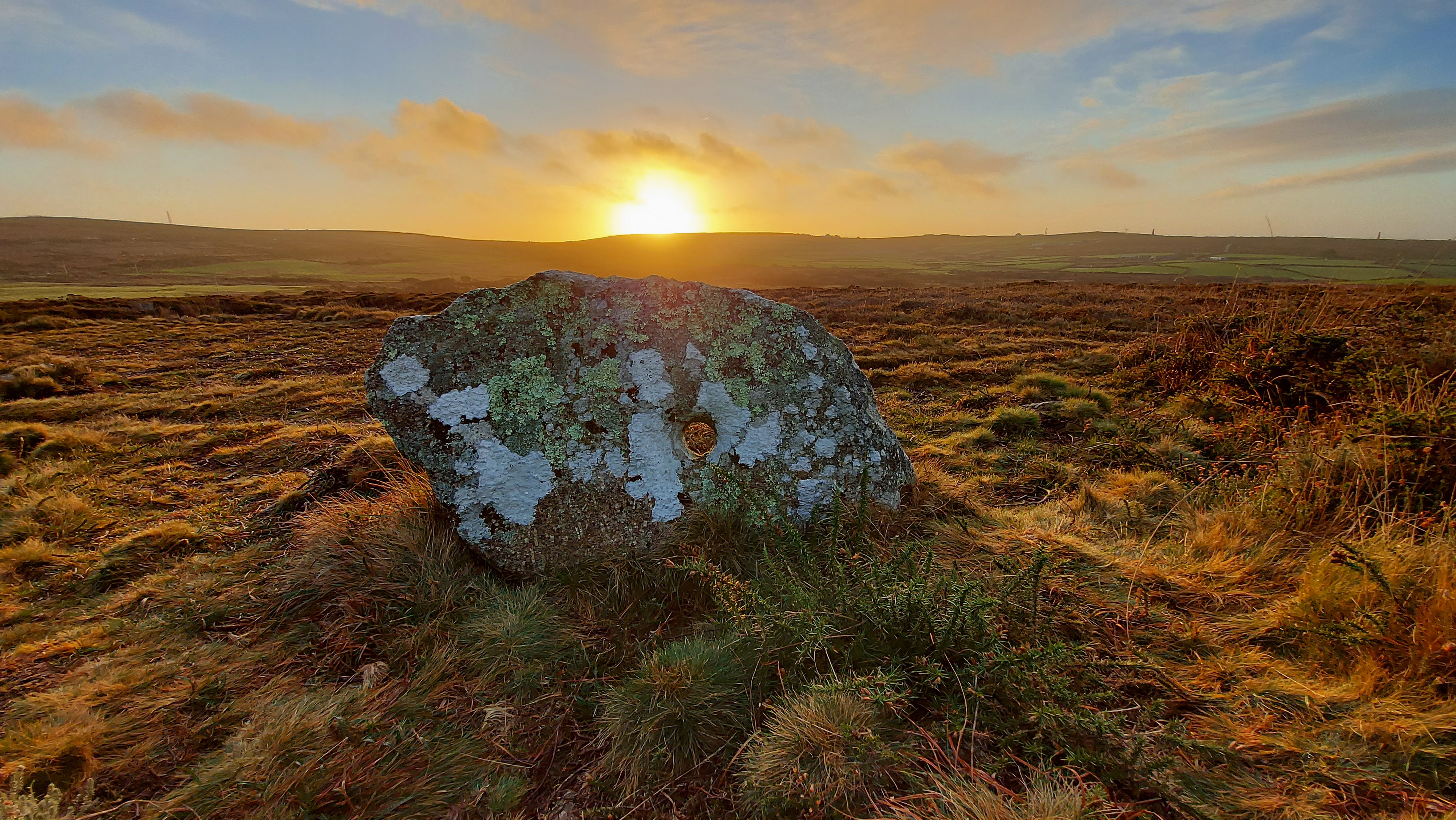
Image: Sunrise 17th December 2020
Credit: Carolyn Kennett
[1] Buller, John (1842) A Statistical Account of the Parish of St Just in Penwith in the County of Cornwall. Dyllansow Truran p. 100
[2] https://historicengland.org.uk/listing/the-list/list-entry/1006755?section=comments-and-photos
[3] Charles Henderson’s 1922 sketch of the stones (taken from the 2011 report on the conservation works to the lone stone – Preston-Jones, A, 2011. Kenidjack holed stone, St Just, Cornwall – repair and restoration. Truro: Cornwall Archaeological Unit, 2011R119)
[4] Kennett, Carolyn (2021) Burying the Sun, Crossed Based Urns and Solar Symbolism. Astronomy Yearbook, White Owl Press. p 152.
[5] Kennett, Carolyn (2021) Tregeseal Circles and the Solstice Sun. Meyn Mamvro Vol 2. No 3. pp.8-10.
 Archaeoastronomy Cornwall
This is so interesting. I spent a long time at the stone circle and Carn Kenidjack in June, and walked around to the east, but didn’t find the holed stones. Wish I could have heard your talk in St. Just last night, but I live in California. Some of my ancestors came from St. Just, and I love visiting there.
LikeLike