
It seems fitting that I am posting this on Beltane, as it was one of Norman Lockyer’s favourite associations, which he explored, making connections between ancient sites and the sky (particularly in Cornwall) at this time of year.
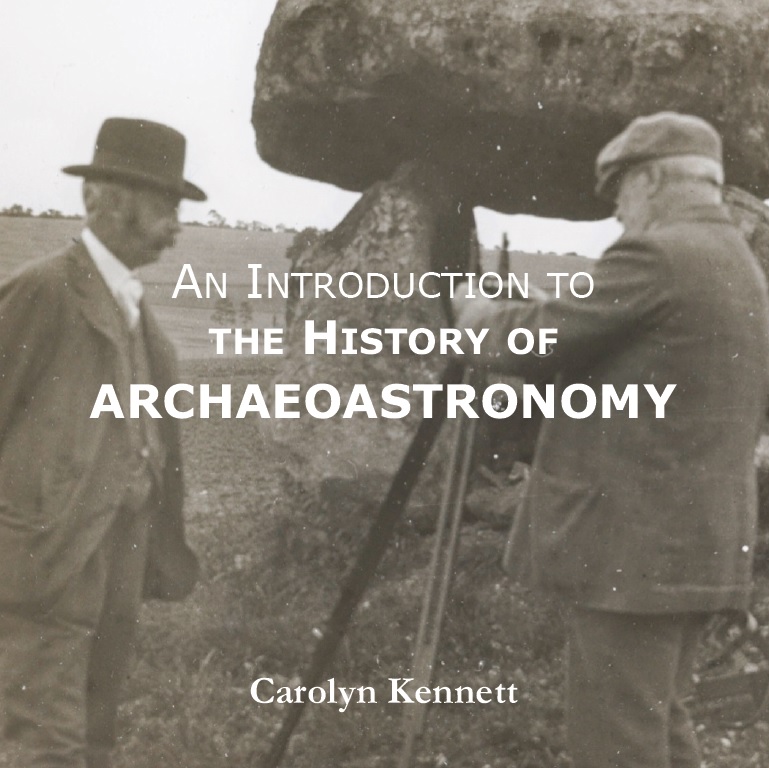
I have written this booklet as part of a series for the Society for the History of Astronomy. In it, I discuss Lockyer’s work alongside that of the many who came before and after him. Lockyer also features on the cover (many thanks to the Norman Lockyer Observatory for permission to use their image).
The booklet can be ordered through the Society for the History of Astronomy and costs £15, including postage and packaging within the UK. All proceeds go to this wonderful organisation, of which I am the current chair.
Here’s the blurb:
An Introduction to the History of Archaeoastronomy
by Carolyn Kennett
For thousands of years, human civilisations have looked to the sky, recording the movements of the sun, stars, and planets in ancient texts. From the cuneiform tablets of Mesopotamia to the hieroglyphs of Egypt, references to celestial bodies abound.
Alongside these written records, numerous ancient structures across the globe appear to be aligned with the cardinal directions or with celestial events such as solstices and equinoxes. These structures—stone circles, burial mounds, and vast earthworks—are especially prominent throughout the United Kingdom and Ireland.
Unlike the civilisations of the ancient Near East and Mediterranean, we do not have written records to accompany many of these monuments. Their meanings have therefore been left to the investigations (and sometimes the imaginations) of those intrigued enough to study them.
Over time, scholars, archaeologists, and astronomers have examined these sites, proposing that many were designed with the movements of the heavens in mind. In doing so, they offer insights into how our ancestors may have understood and interacted with the cosmos.
This booklet traces the development of these interpretations—from their tentative beginnings to more systematic and scientific approaches. It explores the stories behind the theories, the people who proposed them, and the criticisms they faced, presenting a concise history of archaeoastronomy in Britain and Ireland as it developed into a multidisciplinary academic field.
ISBN: 978-1-7393246-3-6

